
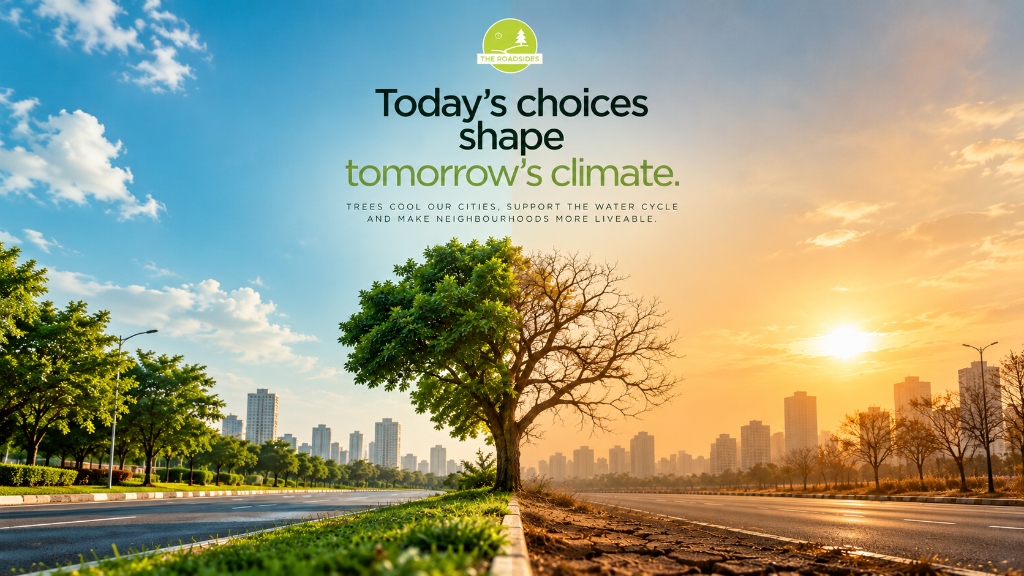
A few years ago, climate change felt like an abstract conversation for many of us. It was discussed in terms of melting polar caps, international summits, and target years decades into the future. Today, that abstraction has vanished. Across Delhi NCR and urban India, we talk about blistering summer heatwaves, acute water shortages, and erratic monsoon rainfall simply because we can feel their direct consequences in our daily commute and living rooms.
Yet amidst these intensifying urban temperatures, there is a fundamental contradiction we often walk right past without noticing.
The Quiet Loss of Urban Canopy
The very cities struggling most under extreme heat are simultaneously stripping away their own natural thermal defense: mature canopy trees, porous green verges, and continuous shaded roadsides. Every season, roadside green belts are cleared or concretized for minor street widenings, utility trenches, or temporary convenience.
When living soil and grass are replaced with unbroken asphalt and interlocking paver tiles, the urban heat island effect worsens rapidly. Exposed road surfaces absorb solar radiation throughout the day and re-radiate that trapped heat well into the night, turning whole neighborhoods into baking ovens.
"Trees cannot solve climate change on their own. But they cool our cities, support the water cycle, and make neighbourhoods liveable."
Living Infrastructure, Not Merely Decoration
A mature tree canopy acts as a living thermal shield. It intercepts harsh sunlight, cools the ambient air through natural transpiration, and prevents blacktop pavements from reaching dangerous surface temperatures. Beneath our feet, unpaved roadside soil acts as a vital sponge, allowing monsoon runoff to percolate into aquifers rather than flooding streets.
And once mature shade trees are lost, replacing their protective value takes decades. A sapling planted today is a hopeful promise for the future, but it cannot immediately replace the deep shade, carbon capture, or cooling envelope of a thirty-year-old neem, peepal, or jamun tree.
Environmental breakdown in our cities rarely begins with a single catastrophic decision. More often, it happens through small, unnoticed compromises: a tree removed here, a roadside verge paved over there, until heat and dust become accepted as unavoidable facts of urban life.
Small Steps, Real Resilience
We cannot control global atmospheric shifts from our doorsteps. But we can take responsibility for the immediate physical spaces we navigate every day. Protecting an existing tree from being choked with cement, restoring an unpaved roadside, and nurturing green verges across our sectors may seem like small steps.
At The Roadsides, our on-ground work in Faridabad and the wider NCR is built on this exact premise. When citizens, schools, and local authorities come together to restore neglected roadsides, we create micro-ecosystems that lower neighborhood temperatures and restore dignity to public spaces.
They are steps worth taking. Because the climate we live in tomorrow is determined by the choices we make along our roadsides today.